
Bottle Mould Buying Guide
Once you Go through this guide you'll have an advantage of getting the best mould and die for your business and your brand.
SAKET (AMS)
7/10/20264 min read
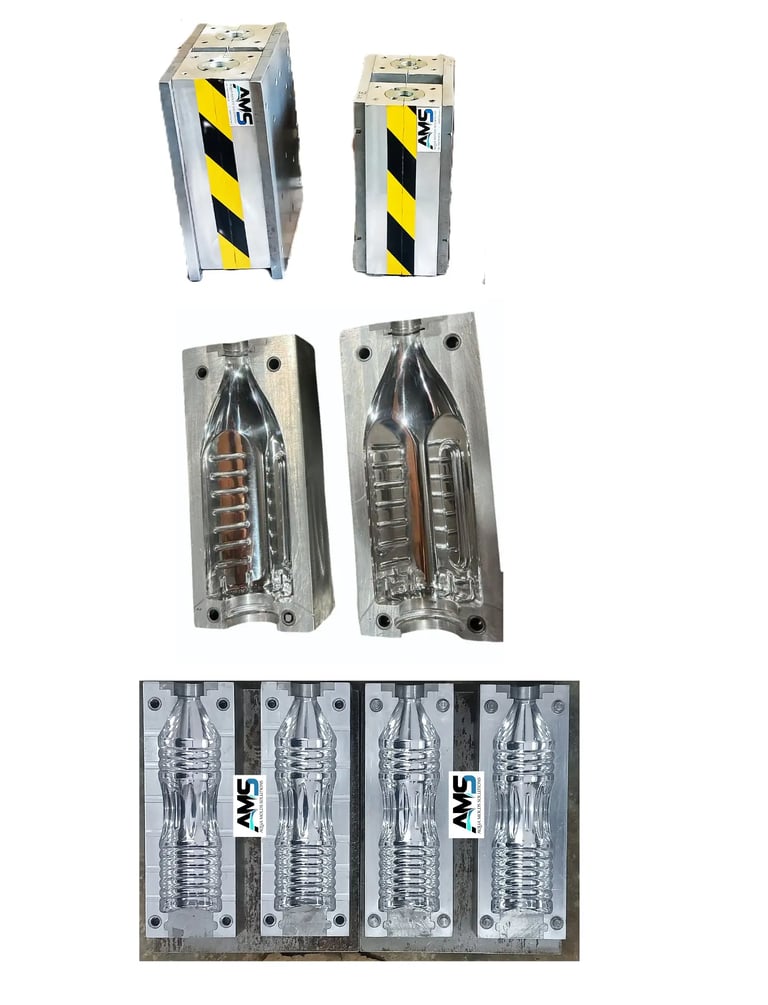
PET Bottle Mould Manufacturer in India: Complete Buyer’s Guide For Buying Your First Mould
Selecting the right PET bottle mould manufacturer is an important decision for any bottle manufacturing business. The mould affects the appearance of the bottle, production consistency, cooling performance, parting-line finish and compatibility with the blow moulding machine.
A low-priced mould may appear economical initially, but incorrect dimensions, weak cooling, poor cavity alignment or repeated fitting work can increase production costs. Buyers should therefore evaluate the complete mould specification instead of comparing suppliers only by price.
What Is a PET Bottle Mould?
A PET bottle mould is a precision-manufactured tool used to form heated PET preforms into finished bottles. When high-pressure air enters the preform, the material expands against the inner cavity of the mould and takes the required bottle shape.
In India, buyers may use different terms for the same product, including:
PET bottle mould
PET bottle mold
Bottle die
Blowing mould
Blow mould
PET mould die
Technically, “mould” or “mold” is the more accurate term for PET blow moulding. However, “bottle die” is also commonly used by buyers searching for bottle manufacturing equipment.
Types of PET Bottle Moulds
PET bottle moulds can be manufactured for many applications, including:
Water Bottle Moulds
These moulds are used for packaged drinking water, mineral water and refrigerator bottles. Common requirements include lightweight bottle designs, good grip, proper base formation and fast cooling.
Edible Oil Bottle Moulds
Oil bottle designs generally require comfortable handling, controlled panel strength and sufficient space for labels. Round, square and rectangular bottle shapes can be developed depending on the customer’s branding requirements.
Juice and Beverage Bottle Moulds
Beverage bottles may require attractive ribs, premium surface designs and good structural strength. The design must also consider filling conditions and the required preform weight.
Pharmaceutical and Cosmetic Bottle Moulds
These bottles normally require accurate dimensions, clean surfaces and a professional appearance. Small-volume bottles may require greater attention to neck alignment and fine design details.
PET Jar Moulds
PET jar moulds are used for food products, dry fruits, spices, confectionery, supplements and household products. Wide-mouth neck dimensions and proper jar base design are important for smooth production.
Custom Bottle Moulds
A custom bottle mould is manufactured according to the buyer’s required capacity, shape, neck size, branding area and machine specifications. Customisation can include logos, grip patterns, ribs, panels and special base designs.
Information Required Before Manufacturing a Bottle Mould
A professional mould manufacturer should collect complete technical information before beginning production.
The buyer should provide:
Required bottle capacity
Bottle height and maximum diameter
Neck size and neck standard
Preform weight
Number of cavities
Blow moulding machine make and model
Back-plate measurements
Required bottle sample or 3D design
Label dimensions
Machine compatibility is especially important. A mould designed without checking the machine dimensions may require modification during installation.
Important Factors When Choosing a PET Bottle Mould Manufacturer
1. Mould Material
Aluminium grade 6063 is commonly used for PET bottle mould cavities because they provide good machinability and heat transfer. The suitable material should be selected according to the bottle application, production requirement, budget and expected mould life.
The buyer should ask the manufacturer to clearly mention the proposed cavity, neck and back-plate materials in the quotation. Always ask for JINDAL or HINDALCO Aluminum. No Local market aluminium can outperform these two brands.
2. Bottle Design Capability
A bottle should not only look attractive; it should also perform properly during manufacturing, filling, transport and use.
A practical bottle design considers:
Preform weight
Material distribution
Bottle height-to-diameter ratio
Grip requirement
Label area
Panel strength
Base stability
Desired appearance
Decorative ribs and panels should have a functional purpose. Excessively deep designs can create production difficulties and may prevent the bottle from releasing smoothly from the mould.
3. Bottle Design and practicality
Bottle Design should be symmetrical in most cases and also practical for real life conditions. So always choose a manufacturer with Best designs.
4. Cavity Alignment
Both mould halves should align correctly when the mould closes. Accurate alignment helps maintain the bottle profile and minimises unwanted parting-line marks.
The alignment system, pillar-bush arrangement and mould-fitting quality should be checked carefully, particularly in automatic and high-speed machines.
5. Surface Finish
The required cavity finish depends on the bottle design. Transparent bottles generally require a smooth, polished cavity surface, while selected design areas may use a textured or matte finish.
The mould surface should be uniform and free from machining marks that could transfer to the finished bottle.
6. Neck and Base Accuracy
The neck area must be compatible with the required preform and closure. The bottle base must also form correctly and provide sufficient stability.
Incorrect neck or base dimensions can create serious production issues even when the remaining bottle design appears correct.
7. After-Sales Support
A mould manufacturer should provide support if fitting corrections, design modifications or troubleshooting are required. Before ordering, buyers should understand the supplier’s correction and after-sales policy.
Questions to Ask Before Placing an Order
Before finalising a bottle mould manufacturer, ask:
Which materials will be used?
Is bottle-design approval included?
Will a 2D drawing or 3D model be shared?
How will machine compatibility be confirmed?
What cooling arrangement will be provided?
What is included in the quoted price?
What is the expected manufacturing time?
Is testing or sample development available?
What support is provided after delivery?
Are design modifications chargeable?
A detailed written quotation protects both the buyer and the manufacturer from misunderstandings.
Why Choose Aqua Mold Solutions?
Aqua Mold Solutions develops PET bottle moulds according to the buyer’s bottle and machine requirements. We work on standard as well as customised mould designs for water bottles, edible oil bottles, jars, pharmaceutical containers, household products and other PET packaging applications.
Our process focuses on:
Understanding the required bottle application
Checking machine compatibility
Preparing practical bottle designs
Sharing the design for approval
Precision machining and fitting
Appropriate cavity finishing
Clear communication during manufacturing
Support after mould delivery
Customers can share an existing bottle sample, drawing, reference image or required capacity. Our team can then evaluate the design and suggest a suitable mould solution.
Conclusion
The right PET bottle mould can improve product appearance, production consistency and overall manufacturing efficiency. Buyers should evaluate design capability, mould materials, cooling, machine compatibility, alignment and after-sales support before placing an order.
For a quotation from Aqua Mold Solutions, share your bottle capacity, neck size, preform weight, machine details, number of cavities and preferred bottle design through our website contact page.
Quick links
saketrajput9573@gmail.com
E-84, ground floor Sector 07 Noida gautam buddha nagar uttar pradesh india (201301)
+91-7310769809 WhatsApp & Call
© 2025. All rights reserved by aqua mold solutions.
Store
Feel free to contact us for mold enquiry
CONTACT US